
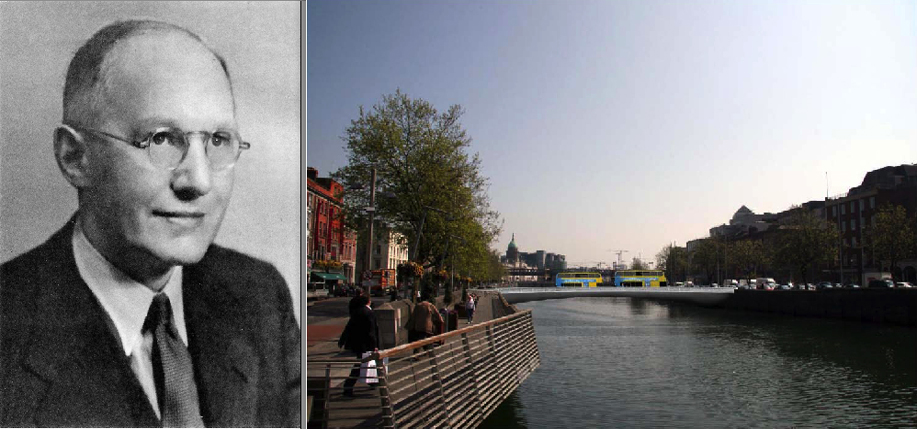
A number of Irishmen have been recognized as Nobel Prize winners: Yeats, Shaw, Beckett and Heaney for Literature, Sean MacBride and John Hume for Peace. But only one Irishman has ever received the Nobel Prize for Physics. In 1951, Irish physicist Ernest Walton and partner John Cockcroft won the Nobel Prize for their invention of the first particle accelerator to split the atom. The Institute of Physics (IOP) Ireland believes that Walton’s recognition is long overdue.
The IOP are now campaigning to have the Marlborough Street Bridge, which is in its early stages of construction, named “The Ernest Walton Bridge” in honor of one of the greatest scientists of the 20th century. The institute created an online petition to garner support in pressuring the Dublin City Council. When the bridge is complete, it will span the River Liffey and will function as a transport, cycle and pedestrian bridge connecting Marlborough Street and Hawkins Street.
Aside from wanting to properly recognize Walton, the IOP has other reasons for calling the bridge “The Ernest Walton Bridge.” This year, Dublin was named European City of Science 2012. Additionally, 2012 marks the 80th anniversary of Walton’s work on splitting the atom in 1932. Therefore, the IOP and its supporters believe 2012 is the perfect year to commemorate Walton. They also hope national recognition of Ernest Walton will “inspire school children to pursue careers in science and technology, a key objective of the [Irish] Government,” said the institute.
Born Ernest Thomas Sinton Walton in County Waterford on October 6, 1903, he found himself excelling in mathematics and science from an early age. He studied at Methodist College, Belfast, and in 1922 he entered Trinity College Dublin. In 1927, he went on to receive his Masters in Science degree. That same year he received a research scholarship and attended Cambridge University to work at the Cavendish Laboratory.
He earned his PhD in 1931. In 1932, while still at the Cavendish Laboratory, Walton and Cockcroft built an apparatus that split the nuclei of atoms after bombarding them with accelerated protons. This invention paved the way for modern nuclear physics, including the groundbreaking Higgs Boson discoveries currently under way at the Large Hadron Collider at CERN.
After his work at Cavendish, Walton returned to Ireland and taught. He had a productive relationship with the government, often writing to propose new methods for economic and scientific development. Walton died in 1995 at the age of 91.
Leave a Reply